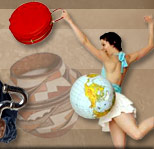
Photoshop: Secrets of Pros is a book that features one-on-one competitions between twenty top artists and designers. Designers include some of most talented web, print, broadcast, 3D designers in world. This friendly competition was called Photoshop Tennis.
Sounds like another tiring outdoor game? It’s not an outdoor game and it’s not tiring. Well, it may be tiring in a way but not, at least, for those skilled designers.
The Photoshop Tennis was invented by Jim Coudal, founder of Coudal Partners, a Chicago advertising and design agency, one summer before September 11 terrorist attack. He and a friend “whacked” a file back and forth to kill time. Then he invited designers he knew to play in official matches.
Photoshop Tennis is an on-line game in which players are mostly web designers. The object of game is to add one layer of design on an image document that is sent back and forth by two players. Only one image document is used. Players are allowed to put different layers of designs such as background and foreground. Results are posted on a website in real time. The game ends whenever players decide to end it or if it takes hours decision will be based on number of votes.
After four test matches and four official matches were completed, designers from ad agencies and design shops visited his site. Some of them contacted Coudal for a chance to play in a match.
The book PhotoShop: Secrets of Pros is all about this type of competition. It is first book to feature such game. As explained by author of site http://photoshop.digitalmedianet.com/articles/viewarticle.jsp?id=22104, in Photoshop Tennis in this book, two designers take on one another over internet over a ten round or volley period. In each volley, designer either creates a new theme (in initial volley), or they take what has been sent to him or her and start playing off of what was previously created. The competition results to a different appearance each time out. Programs used in this competition range from Illustrator and Freehand to Flash to 3D Studio Max and Maya. The designers used basic tools and basic commands like, brushes, and fills instead of shortcuts.